
Beyond COP deadlock: summit for fossil fuel transition shows promise


The First Conference on Transitioning Away from Fossil Fuels, held in Colombia in April, came at a defining moment. The war in Iran and the blockade of the Strait of Hormuz have laid bare the insecurity caused by fossil fuel dependency and strengthened the case for a renewable energy transition. Fifty-seven states attended the summit, designed to bypass the deadlock of annual United Nations climate talks, and committed to developing national roadmaps on transition and reforming international financing. The summit demonstrated that more joined-up approaches to the climate crisis are possible, with civil society, Indigenous leaders and scientists playing a central role. Now the challenge is implementation.
The Israeli-US war on Iran and the resulting blockade of the Strait of Hormuz are driving yet another oil shock. Fuel prices are spiking, the cost of living is rising again and the disruption to agricultural fertiliser supplies threatens a food crisis. The world’s fossil fuel addiction looks increasingly reckless.
Against this backdrop, 57 states came together and offered a path forward. At the First Conference on Transitioning Away from Fossil Fuels, hosted by Colombia in cooperation with the Netherlands, they agreed to develop national roadmaps to phase out fossil fuel production and consumption.
The conference, held from 24 to 29 April in Santa Marta, Colombia, grew out of frustration with the annual global summits of states under the United Nations Framework Convention on Climate Change, known as conferences of parties (COPs). The 30th of these was held in Brazil last November, and once again it made no political commitment to end fossil fuel use. The requirement for consensus decisions means that petrostates such as Saudi Arabia routinely block progress until any language on fossil fuels is rendered close to meaningless. More ambitious states were forced to set up this new forum on transition outside the COP process.
New commitments
In contrast to the COPs, the Santa Marta summit was based on an explicit understanding that the main driver of the climate crisis is the extraction and use of fossil fuels, and any solution depends on phasing them out. The chief commitment was to develop national roadmaps on phasing out fossil fuels, recognising the need to go further than the nationally determined contributions plans each state is required to submit as part of the COP process.
The 57 states represented in Colombia generate over half of the world’s GDP. Around half produce fossil fuels, including Angola, Brazil and Nigeria, meaning they’ll need to show how they plan to stop doing so.
Colombia led the way, presenting its draft roadmap. The country currently earns around half of its export revenues from coal, gas and oil, but plans to introduce renewables that will ultimately deliver net economic gains while bringing long-term health and security benefits. The plan shows that up-front investment is needed to support the transition, but a low-emissions economy is viable in the long term.
The meeting made clear that the financial system needs to change to enable transition away from fossil fuels. Financial incentives are currently misaligned. Global south states are forced to hand over much of their precious foreign exchange earnings to pay interest on international debt, leaving them with little to invest in transition. Meanwhile fossil fuel companies benefit from subsidies that many states provide. The International Monetary Fund assesses that what it calls explicit subsidies, where states make direct outlays from their budgets, amounted to US$725 billion in 2024, while implicit subsidies, the costs of environmental and social impacts that fossil fuel corporations don’t pay, came to US$6.7 trillion, 5.8 per cent of global GDP. Fossil fuel corporations can also invoke legal mechanisms that settle disputes between states and the private sector to claim compensation when states bring in measures to curb extraction, and since 1998 have received over US$80 billion by doing so.
The war in Iran makes these financing challenges still more urgent. Inflation will almost certainly push interest rates higher, squeezing global south countries already burdened by high debt. The extra costs imposed on countries by higher prices could total US$1 trillion. Meanwhile, the fossil fuel industry is raking in windfall profits. BP’s profits have more than doubled since the start of the war. The world’s biggest oil and gas companies are on course to make an extra US$234 billion by the end of the year if the war in Iran continues.
The meeting offered tangible steps on this front, setting up a process to work on changing the financial system, including by finding solutions to the debt issue and identifying fossil fuel subsidies, which could be repurposed to support transition.
Climate democracy
The summit’s working methods also marked a departure from climate COPs. Scientists held their own meeting, and broadly left Santa Marta feeling they’d been taken seriously and listened to. The conference saw the launch of a new initiative, the science panel for global energy transition. This is a group of scientific experts ready to give advice to any government that wants to know how to reduce fossil fuel dependence. Alongside climate scientists, it includes economists and technology specialists, reflecting the need for integrated approaches to the climate crisis.
Civil society participation, including by Indigenous representatives, was also much stronger than at COPs. Civil society took part in breakout session discussions alongside ministers and scientists. Indigenous groups, key defenders of areas at risk from extraction, took the opportunity to push for a new approach to mining minerals needed for the transition.
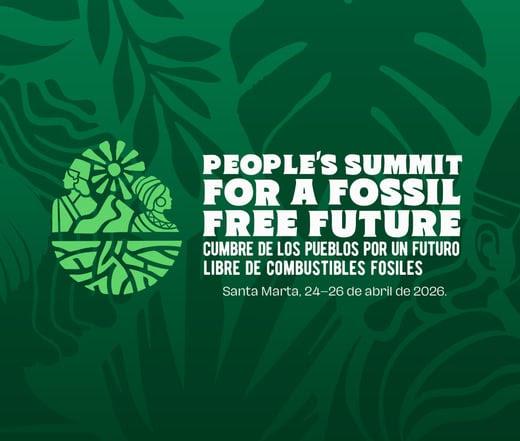
A separate, self-organised People’s Summit for a Fossil-Free Future brought together over 900 people to issue a declaration that sets out a series of principles for a just transition with human rights at the centre, including the need for sustainable and equitable use of transition minerals, the removal of financial and fiscal barriers to global south transition and stronger international solidarity and cooperation. The declaration calls for action to tackle the barriers to transition, including reform of COP processes and structures.
Time for transition
The security argument for transition has never been clearer. A handful of powerful and typically autocratic petrostates, effectively captured by the fossil fuel industry, are the only ones that can benefit from a crisis like the war in Iran. Most states will always be vulnerable to oil shocks, and as the current situation shows, one reckless decision by a superpower can bring repercussions for all. As Donald Trump seeks energy dominance for the USA, energy sovereignty lies in renewables.
States must learn the right lessons from the crisis. Falling back on short-term measures such as returning to burning coal or increasing liquefied natural gas imports is the wrong response to oil price spikes. The correct response is to speed up the transition to renewables.
Change is underway. Renewables provide around 30 per cent of electricity globally. Renewable electricity investment, at US$2.4 trillion, is more than double fossil fuel investment. The Iran war has accelerated the pace. South Korea has announced a big expansion of its solar power plans. Europe’s electric vehicle sales have increased 51 per cent since the start of the war, and the European Union has increased its incentives to switch. But much more is needed, and more quickly. The financing barriers that prevent global south countries moving away from fossil fuels must be addressed.
It’s also essential to bring more countries into the coalition. As it stands, the new summit exemplifies a growing global governance trend of selective multilateralism. With the most powerful states increasingly refusing to play by the international rules, it’s getting harder to reach consensus on pressing issues that cross borders. States that want progress are having to forge alternative structures. Advances can result, but they bring the risk of dividing the world into two groups of states: those that follow the rules and those that choose to act unilaterally.
The summit organisers didn’t invite China, India, Russia or the USA, on the basis that they haven’t shown sufficient willingness to cooperate and could be expected to block agreements. Under their current leaders, Russia and the USA can’t be expected to act in good faith, but China could have an important role to play, as both the world’s current biggest greenhouse gas emitter and the global leader in developing and implementing fossil fuel alternatives and supplying the technology required. As the process launched by this summit will report to future COPs, powerful allies that can win influence at those peak negotiations will be needed.
The challenge as the process evolves will be to bring more states into the coalition, without compromising on what must be a red line: acknowledgement of the need to end fossil fuel use. China, India and any others should be expected to make clear their political commitment to rapid transition and to breaking the financing deadlock.
Looking ahead
The Colombia talks are a promising start, offering an energising change from the deadlock of COPs. They’ve shown that climate democracy is possible. Now they must demonstrate that this model leads to progress, rapidly and at scale. Countries must deliver on ambitious transition plans. To mobilise the investment needed, they must also change approaches to debt, redirect fossil fuel subsidies towards transition and match potential investors to new national roadmaps.
There are potential leadership challenges ahead. Colombia is playing a key role, but that could change with an election at the end of this month, which may see a far-right populist challenger committed to ramping up oil production take the helm. Politics in the Netherlands, co-leader of this process so far, is also fragile. The far right has been part of recent governments and the current coalition government has just announced a new North Sea drilling plan.
A global surge in economic anger as prices rise could well drive another increase in influence for right-wing populists and nationalists who peddle simplistic solutions and promise what looks like change, while invariably demanding more fossil fuel extraction. Politicians who want to break the grip of the world’s fossil fuel addiction must learn to speak more directly to economic grievances. And for this new process, alternative leaders must be waiting in the wings to step in if changes of government cause states to pull out.
Crucial waypoints will be COP31, hosted by Turkey, and the next meeting in this series. Tuvalu – one of the low-lying island nations that have done almost nothing to cause the climate crisis but face its gravest consequences – will co-host it alongside Ireland in 2027. That a nation at risk of disappearing from the map will anchor the summit offers a reminder of what’s at stake. Civil society must keep this process on track.
OUR CALLS FOR ACTION
-
The coalition of states committed to transitioning away from fossil fuels must grow its membership and lead by producing ambitious national roadmaps for their transition.
-
States must work with the scientific community, civil society and Indigenous people in preparing and implementing transition plans.
-
States must unlock the financing needed for a global transition by restructuring global south debt and ending fossil fuel subsidies, redirecting the funding towards renewables.
For interviews or more information, please contact research@civicus.org
Cover photo by Raul Arboleda/AFP