
International tensions spark new nuclear threat


The 62nd Munich Security Conference showed the extent of the rupture in the international order. The USA preceded it by withdrawing from 66 international bodies and commitments and allowing the last nuclear arms control treaty to expire. German Chancellor Merz announced talks with France on extending its nuclear umbrella to cover Europe, an idea until recently unthinkable. Outside the conference, 200,000 people demanded accountability for Iran’s massacre of protesters, a crisis the United Nations Security Council failed to address because China and Russia used their vetoes. The conference revealed the scale of the breakdown but offered no hope of a more democratic and inclusive form of multilateralism.
When German Chancellor Friedrich Merz opened the 62nd Munich Security Conference by declaring that the post-war rules-based order ‘no longer exists’, there was plenty of evidence to back his claim. Israel is committing genocide in Gaza in defiance of international law. Russia is four years into its invasion of a neighbouring state despite being a permanent member of the United Nations (UN) Security Council. The last nuclear arms control treaty between Russia and the USA expired days before the conference opened. The USA had just withdrawn from 66 international bodies and commitments, including the UN Democracy Fund, the UN Framework Convention on Climate Change and UN Women. The UN is undergoing a funding crisis, cutting staff and programmes. Civil society organisations that relied on US Agency for International Development funding are having to close. The global architecture constructed after 1945, including the UN Charter’s prohibition on territorial conquest, NATO’s collective security agreement and the nuclear arms control framework, is no longer functioning as designed.
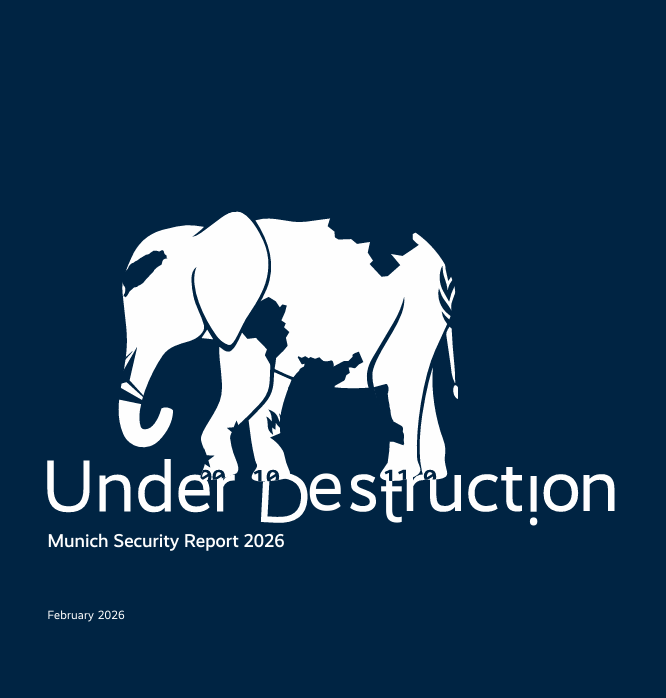
Inaugurated in 1963 as a transatlantic defence meeting, the Munich Security Conference has grown into the most significant annual meeting on global security, with heads of state, foreign ministers, civil society, think tanks and the media taking part. The 2026 edition focused on the theme ‘Under Destruction’ and convened over 1,000 participants from more than 115 countries, including over 60 national leaders, alongside China’s Foreign Minister Wang Yi and US Secretary of State Marco Rubio, UN High Commissioner for Human Rights Volker Türk and the directors of multiple UN agencies.
The conference’s Munich Security Report 2026 provided the analytical backdrop. It argued that the world has entered a period of ‘wrecking-ball politics’, with the post-1945 order, constructed over eight decades, being demolished by political forces that prefer disruption to reform faster than alternatives can be built. The report’s Munich Security Index showed the scale of the crisis. In France, Germany and the UK, absolute majorities of respondents said their government’s policies would leave future generations worse off. Across most BRICS and G7 countries, the USA is now rated as a growing risk.
A damaged relationship
The world had been bracing for Rubio’s keynote address. Last year, US Vice President JD Vance’s aggressive speech accused European governments of suppressing free speech and aligning with political extremism, seemingly blind to the irony. Rubio took a more conciliatory tone, calling Europe America’s ‘cherished allies and oldest friends’. European Commission President Ursula von der Leyen said she was ‘very much reassured’. Half the hall rose to applaud.
The substance of the speech, however, followed every position Vance advanced the year before. Rubio defined the transatlantic relationship not around shared democratic institutions or international law, but around ‘Christian faith, culture, heritage, language, and ancestry’. This framing drew anger from global south delegates, who understood its explicit claim of global north cultural and racial superiority, excluding the majority of humanity.
Rubio described the UN as an organisation with ‘no answers’ that had played virtually no role in Gaza or Ukraine, choosing to ignore its vital provision of emergency food, water, shelter and medical care in very difficult circumstances. He called migration an urgent threat and dismissed climate action as driven by a ‘cult’.
The Trump administration was making a strategic calculation, having evidently concluded that Vance’s confrontational tone had backfired, bringing Europe closer to China and making it more reluctant to endorse US-led initiatives. So it switched to a softer messenger without changing the message.
Rubio’s post-conference itinerary made the USA’s current priorities clear. He flew directly from Munich to Budapest and Bratislava to meet two nationalist leaders, Hungarian Prime Minister Viktor Orbán and Slovak Prime Minister Robert Fico. Both are pro-Trump and friendly towards Vladimir Putin. These are the European politicians the Trump administration considers its true allies. Now the USA is planning to fund right-wing think tanks and charities across Europe in a blatant attempt to influence the continent’s politics.
Europe’s rearmament
Merz’s diagnosis led to a historic move: he and French President Emmanuel Macron announced they’d begun talks on extending France’s nuclear umbrella to cover other European countries. This is a development it would have been hard to imagine just a year ago. For decades European countries have based their security policies on NATO and its article 5, the collective defence commitment. But the Trump administration has threatened not to respect Article 5 and used this threat to force European states to spend more on defence. European states have embarked on the long and expensive process of detaching themselves from reliance on Article 5, and now this includes the exploration of nuclear alternatives.
Von der Leyen described the move as a ‘European awakening’ and called for a ‘mutual defence clause’ to be brought to life. UK Prime Minister Keir Starmer called for ‘hard power’ and readiness to fight if necessary. Poland’s President Karol Nawrocki said his country should get nuclear weapons. By responding in this way to the unravelling of the multilateral order, Europe is further weakening the norms of non-proliferation and arms control that the post-war order sought to sustain. Responding to crisis with a second nuclear arms race could bring still further instability. Spain’s Prime Minister Pedro Sánchez was the only European leader at the conference to warn against this.
By skipping a session on Ukraine with European leaders, Rubio also made clear the USA isn’t taking Ukraine seriously, which can only be good news for Putin. Ukraine’s President Volodymyr Zelenskyy used the summit to continue to reject Russia’s insistence it should simply hand over vast parts of its territory in return for an end to the fighting, setting out three non-negotiable demands: US missile defences, security guarantees for a minimum of 20 years and a clear date for European Union (EU) accession. Despite recent rounds of talks in Abu Dhabi and Geneva, a peace agreement seems no nearer.
Danish Prime Minister Mette Frederiksen meanwhile warned that US ambitions over Greenland hadn’t gone away despite a compromise being struck at the World Economic Forum. On both Greenland and Ukraine, it’s evident many European states no longer believe they can trust the USA.
Outside the conference
Another contemporary crisis dominated the streets outside the venue. On the meeting’s final afternoon, over 200,000 people protested in Munich to demand change in Iran. The backdrop was Iran’s biggest uprising since the 1979 revolution. Sparked by economic collapse, mass protests started in December 2025 before being crushed with extraordinary brutality. While world leaders debated the architecture of global security in Munich, Revolutionary Court judges in Iran were handing down summary death sentences to protesters.
The protest laid bare the complexity of the debate over Iran’s future. Reza Pahlavi, exiled son of the shah ousted in the 1979 revolution, spoke to praise the US administration for deploying a second carrier group to the region, calling for intervention. Israeli flags were carried alongside Iranian monarchical ones. The diaspora is divided between very different visions, with the pro-monarchy community just one particularly vocal segment among them.
What’s clearer is that Iran’s theocratic regime expects to get away with a massacre while the international system offers an insufficient response. The conference organisers had invited Iranian government officials, then disinvited them. On 29 January, the EU sanctioned 15 Iranian officials and six government bodies. The UK announced further sanctions targeting Iran’s energy, finance and transport sectors. In an emergency session on 23 January, the UN Human Rights Council extended its Fact-Finding Mission mandate and tasked it with preserving forensic evidence of serious human rights violations. And on 19 February, the EU designated the Islamic Revolutionary Guard Corps, the force at the forefront of the repression, as a terrorist organisation, freezing all its assets in EU states.
These were significant steps, but they fell short. In a familiar failing of the international system, further action has been consistently blocked. The UN Security Council – the only UN institution with the authority to issue legally binding decisions and enforce them through measures that include armed force – couldn’t pass any resolution, as China and Russia used their vetoes. Powerful states once again made clear they can’t be trusted to protect people’s rights and lives.
What this means
The conference’s conclusion was that those who care about the international order must build new institutions, coalitions and frameworks that are fit for purpose and accountable to the people they’re supposed to serve. This reasonable framing sidesteps crucial questions: whose interests institutions serve, and who’s excluded as the blueprints are drawn.
European states’ reaction to the fraying of their old alliances with the USA must be anchored in human rights, genuine multilateralism and a commitment to international law. This will only happen if civil society is present as a partner at the table, not just in the streets outside. Rubio’s redefinition of transatlantic solidarity around a white Christian identity brings all kinds of troubling repercussions for democracy, human rights and international relations. His attacks on climate action run contrary to the policy commitments of many European states and threaten to worsen the human suffering caused by climate change. European states must push back, unmoved by the more comforting tone of Rubio’s delivery.
The right of the Ukrainian people to determine their own future mustn’t be traded away in a deal struck over their heads. Iran shouldn’t be allowed to slip off the agenda as great powers negotiate their interests in the region. The EU’s targeted sanctions need to be matched by a sustained international push for an independent criminal investigation that can collect evidence, feeding into efforts to bring accountability. The UN mission set up for this purpose needs resources and political backing.
It’s clear the old order is broken, and those committed to human rights and opposed to militarisation and naked power politics can’t afford to be bystanders. Their responses need to be more assertive and inclusive. A new international architecture that continues to exclude civil society and sideline the global south will simply reproduce the structures that have failed to address today’s crises.
OUR CALLS FOR ACTION
-
Democratic states must defend United Nations principles and universal human rights as the non-negotiable foundations of the international order, and fill the institutional and funding vacuum left by the USA’s withdrawal.
-
States must support civil society-led documentation and accountability mechanisms for violations of international humanitarian and human rights law, and reject governance frameworks that exclude civil society participation.
-
States must provide full political and financial support to the United Nations Fact-Finding Mission on Iran.
For interviews or more information, please contact research@civicus.org
Cover photo by Michaela Stache/ AFP